

Shalom Medical Team
Shalom Hospital
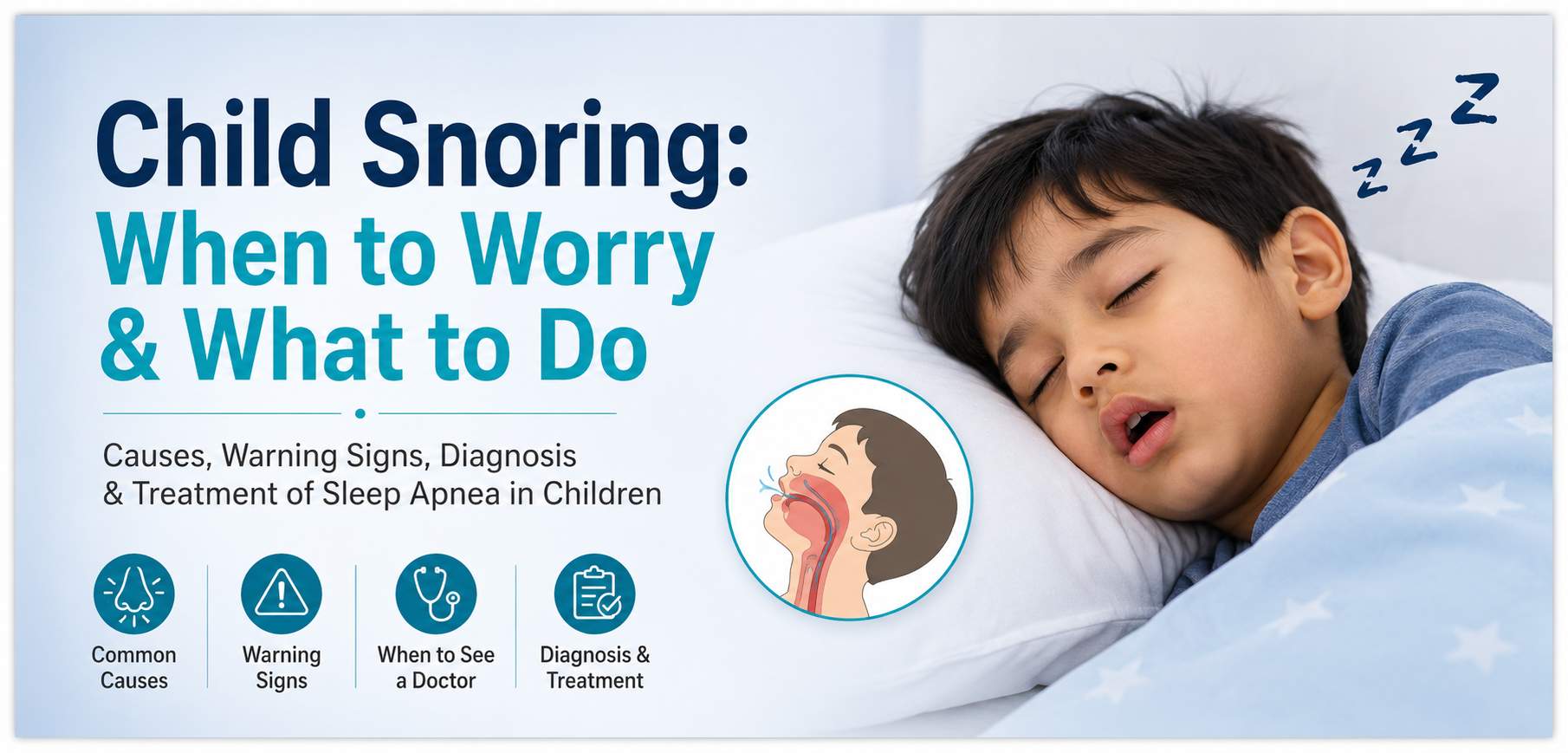
Why Your Child Snores — And When It Becomes a Problem
A little snoring after a cold may be harmless. But if your child snores regularly, sleeps restlessly, breathes through their mouth, or seems unusually tired or irritable during the day, it deserves more attention.
Snoring is common in children, and most children who snore do not have obstructive sleep apnea (OSA). However, persistent or loud snoring can sometimes be a sign that the child’s airway is becoming partially or completely blocked during sleep.
The important question is not simply, *”Does my child snore?”* It is:
What is causing the snoring, and is it affecting the child’s breathing or sleep?
This guide explains the common causes of childhood snoring, the warning signs parents should know, when to see a doctor, and what evaluation and treatment may involve.
Is Snoring Normal in Children?
Occasional snoring is common.
A child may snore temporarily when they have:
- A cold or blocked nose
- Nasal congestion
- Allergies
- Enlarged tonsils or adenoids
- Temporary inflammation of the upper airway
In these situations, snoring may disappear once the underlying problem improves.
The concern increases when snoring becomes frequent, loud, or persistent, particularly when it occurs several nights a week or is accompanied by other symptoms.
Habitual snoring is reported in roughly 10% of preschool and school-aged children, while clinically significant obstructive sleep apnea affects a smaller proportion.
So, snoring does not automatically mean sleep apnea. But persistent snoring should not simply be dismissed as a harmless habit.
Why Does a Child Snore?
Snoring happens when airflow through the upper airway becomes turbulent and causes tissues in the throat or nearby structures to vibrate during sleep.
During sleep, the muscles surrounding the airway naturally relax. If the airway becomes narrower than usual, airflow can become noisy.
Several things can contribute.
1. Enlarged Tonsils and Adenoids
This is one of the most common causes of obstructive breathing during sleep in children.
The tonsils sit at the back of the throat. The adenoids are located higher up, behind the nose.
If these tissues become enlarged, they can narrow the airway, particularly when the child is asleep and the surrounding muscles relax.
Children with enlarged adenoids may also:
- Breathe through their mouth
- Sound congested when speaking
- Have noisy breathing
- Snore at night
Not every child with large tonsils or adenoids develops sleep apnea, so their size alone does not determine whether treatment is necessary.
2. Nasal Congestion and Allergies
A blocked nose makes it harder to breathe normally through the nose.
Colds, allergic rhinitis and chronic nasal inflammation can therefore make snoring worse.
If your child’s snoring appears mainly during periods of congestion and disappears when the nose clears, the pattern may be different from habitual snoring caused by persistent airway narrowing.
3. Excess Weight
Overweight and obesity can increase the risk of obstructive sleep apnea in children because additional tissue around the upper airway can contribute to narrowing during sleep.
This should be approached carefully. A child who snores should not automatically be assumed to have a weight-related problem. Enlarged tonsils and adenoids remain important causes, and children of any body size can develop sleep-disordered breathing.
4. Certain Medical or Structural Conditions
Some children have a higher risk of obstructive sleep apnea because of conditions affecting the airway, facial structure, muscle tone, or nervous system.
Examples include certain craniofacial abnormalities, Down syndrome and neuromuscular conditions.
These children may require earlier assessment by an appropriate specialist.
When Is Snoring a Problem?
The biggest warning sign is not simply the sound of snoring.
Parents should pay attention to what happens to the child’s breathing while they sleep.
Watch for:
- Loud or habitual snoring
- Pauses in breathing
- Gasping, choking or snorting after a pause
- Struggling to breathe during sleep
- Very restless sleep
- Frequent changes in sleeping position
- Sleeping with the mouth open
- Unusual sleeping positions to make breathing easier
- Heavy sweating during sleep
- Bedwetting in a child who previously stayed dry
- Difficulty waking in the morning
- Morning headaches
- Daytime tiredness
- Irritability or mood changes
- Difficulty concentrating
- Learning or behavioural problems
These symptoms can occur with pediatric obstructive sleep apnea.
One particularly important sign is snoring followed by a pause in breathing and then a gasp, snort or choking sound.
That pattern warrants medical assessment.
What Is Obstructive Sleep Apnea in Children?
Obstructive sleep apnea is a condition in which the child’s upper airway repeatedly becomes blocked or significantly narrowed during sleep.
The child may continue trying to breathe, but airflow is reduced or temporarily stops.
The brain can briefly arouse the child to reopen the airway. These disruptions may happen repeatedly throughout the night, sometimes without the child fully waking up.
The result can be fragmented, poor-quality sleep.
Importantly, children do not always look sleepy when they have sleep apnea.
Instead, inadequate sleep can sometimes appear as:
- Irritability
- Hyperactivity
- Difficulty concentrating
- Behavioural changes
- Problems at school
- Morning headaches
- Difficulty waking
Untreated pediatric sleep apnea can affect behaviour, learning, growth and cardiovascular health.
Snoring vs Sleep Apnea: What’s the Difference?
| Occasional/simple snoring | Possible obstructive sleep apnea |
|---|---|
| Happens occasionally | Happens regularly |
| Often occurs during a cold or congestion | Persists even when the child is otherwise well |
| No obvious breathing pauses | Pauses in breathing may be observed |
| Child generally sleeps comfortably | Restless or disturbed sleep |
| No significant daytime symptoms | Daytime tiredness, irritability or concentration problems may occur |
| Improves when congestion resolves | May continue for weeks or months |
This table is a guide, not a diagnostic test. Only a medical assessment can determine whether a child has obstructive sleep apnea.
What Should Parents Do If Their Child Snores?
Start by observing the pattern.
Ask yourself:
How often does my child snore?
Occasional snoring during a cold is very different from loud snoring most nights.
Does my child stop breathing?
Watch for pauses followed by gasping, choking, snorting or sudden movements.
How does my child breathe?
Notice whether they breathe through their mouth, struggle to breathe, or sleep with their neck extended or in unusual positions.
How does my child behave during the day?
Look for excessive tiredness, irritability, difficulty concentrating, morning headaches or behavioural changes.
If possible, record a short video of your child’s sleep, particularly if you notice unusual breathing. A recording can be useful to show the pediatrician or ENT specialist.
When Should You See a Doctor?
Arrange a medical assessment if your child:
- Snores regularly
- Snores loudly most nights
- Has witnessed pauses in breathing
- Gasps or chokes during sleep
- Appears to struggle to breathe at night
- Consistently breathes through their mouth
- Has persistent restless sleep
- Has daytime behavioural, concentration or learning changes
- Has unexplained daytime sleepiness
- Has other risk factors for obstructive sleep apnea
The American Academy of Pediatrics recommends that children be screened for snoring and that children with snoring plus symptoms or signs suggestive of obstructive sleep apnea receive further evaluation.
How Is Childhood Sleep Apnea Diagnosed?
A doctor will usually begin with a detailed history and examination.
They may ask about:
- How frequently the child snores
- Breathing pauses
- Gasping or choking
- Sleep position
- Mouth breathing
- Daytime behaviour and concentration
- Medical conditions
- Allergies
- Tonsil and adenoid symptoms
- Growth and weight
The doctor may examine the child’s nose, throat, tonsils and airway.
Sleep Study
When obstructive sleep apnea is suspected, an overnight polysomnogram (sleep study) may be recommended.
During a sleep study, several physiological signals can be monitored, including breathing, oxygen levels, heart rate and other measurements of sleep and muscle activity.
Polysomnography is considered the objective standard test for distinguishing obstructive sleep apnea from simple or primary snoring.
Not every child who snores necessarily needs a sleep study. The decision depends on the child’s symptoms, examination findings, risk factors and clinical assessment.
Does Every Child Who Snores Need Their Tonsils Removed?
No.
This is an important distinction.
Enlarged tonsils and adenoids are common contributors to childhood obstructive sleep apnea, but simply having large tonsils does not mean a child needs surgery.
When a child has confirmed or strongly suspected obstructive sleep apnea associated with enlarged tonsils and adenoids, tonsillectomy and adenoidectomy (adenotonsillectomy) may be recommended as first-line treatment in appropriate cases.
The decision should be individualized based on the child’s symptoms, examination, severity of sleep-disordered breathing and overall health.
What Other Treatments Are Available?
Treatment depends on the underlying cause.
Treating Nasal or Allergic Problems
If nasal obstruction or allergies are contributing to the problem, treatment directed at those conditions may improve breathing.
For selected children with mild obstructive sleep apnea, intranasal corticosteroids may be considered under medical supervision.
Adenotonsillectomy
Removal of enlarged tonsils and adenoids is a common treatment when they are contributing significantly to obstructive sleep apnea.
However, surgery does not guarantee that every child will have complete resolution, and follow-up may be necessary.
CPAP
Continuous positive airway pressure, or CPAP, provides a steady flow of air through a mask during sleep to help keep the airway open.
It may be considered when surgery is not appropriate, when sleep apnea persists after surgery, or in other selected situations.
Healthy Weight Management
For children who are overweight or obese, healthy weight management may form part of treatment.
It is generally used alongside other appropriate treatment rather than as a reason to delay evaluation of significant airway obstruction.
Can Childhood Sleep Apnea Affect Growth and Development?
It can.
Sleep is an important part of childhood development. Repeated disruption of sleep and breathing can affect daytime functioning and has been associated with problems involving behaviour, attention, learning and growth.
This is one reason persistent snoring deserves attention even when the child appears otherwise healthy.
A child does not have to look exhausted during the day for sleep-disordered breathing to be clinically important.
What About Babies?
Snoring and noisy breathing in infants require a different level of caution because infants have different airway anatomy and sleep physiology.
Occasional noisy breathing does not automatically mean sleep apnea, but persistent, abnormal or difficult breathing in an infant should be discussed with a pediatrician.
Parents should seek urgent medical attention if a child is having significant difficulty breathing, develops blue or grey discoloration, or cannot maintain normal breathing.
A Simple Night-Time Check for Parents
If you are concerned about your child’s snoring, observe them calmly while they are asleep.
Look for:
1. Breathing pattern Is breathing smooth, or are there repeated pauses?
2. Effort Does the chest or abdomen appear to work unusually hard to breathe?
3. Sounds Is there loud snoring, gasping, choking or snorting?
4. Position Does your child repeatedly sleep in unusual positions that appear to help them breathe?
5. Frequency Does this happen only during a cold, or most nights?
6. Daytime effects Is your child unusually irritable, sleepy, inattentive or difficult to wake?
If you repeatedly notice concerning patterns, record them and discuss them with your child’s pediatrician.
🚨 When Is It an Emergency?
Most childhood snoring is not an emergency.
However, seek urgent medical care if your child has severe difficulty breathing, prolonged breathing pauses, blue/grey lips or skin, significant distress, or is unusually difficult to wake.
Severe breathing difficulty should not be monitored at home while waiting for a routine appointment.
The Bottom Line
A child who occasionally snores during a cold usually does not have sleep apnea.
But regular, loud snoring — especially when accompanied by breathing pauses, gasping, restless sleep, mouth breathing or daytime behavioural and concentration problems — deserves medical evaluation.
The goal is not to treat the noise itself.
The goal is to determine whether your child’s airway is being obstructed during sleep and whether that obstruction is affecting their health and development.
If your child snores regularly, don’t panic — but don’t automatically ignore it either. A pediatrician, ENT specialist or sleep specialist can determine whether the snoring is simple or part of a condition that needs treatment.
Frequently Asked Questions
Is it normal for children to snore?
Occasional snoring is common, particularly during colds or nasal congestion. Regular or habitual snoring should be discussed with a healthcare professional, especially when other symptoms are present.
Does snoring mean my child has sleep apnea?
No. Most children who snore do not have obstructive sleep apnea. However, persistent snoring is an important symptom that can warrant evaluation.
What are the most common causes of sleep apnea in children?
Enlarged tonsils and adenoids are among the most common causes. Other risk factors include obesity, certain craniofacial conditions, neuromuscular conditions and chronic nasal obstruction or allergies.
Should I record my child while sleeping?
A short video showing concerning snoring or breathing patterns can be useful when discussing the problem with your child’s doctor. It does not replace a medical examination or sleep study when one is indicated.
Can enlarged tonsils and adenoids cause snoring?
Yes. Enlarged tonsils and adenoids can narrow the upper airway and contribute to snoring and obstructive sleep apnea.
Will my child’s snoring go away as they grow?
Sometimes. Some childhood snoring is related to temporary congestion or enlarged adenoids, which may change as a child grows. But persistent snoring should not simply be assumed to be something the child will outgrow.
Does every child with sleep apnea need surgery?
No. Treatment depends on the cause and severity. Adenotonsillectomy is commonly used when enlarged tonsils and adenoids are contributing to obstructive sleep apnea, while other children may need medical treatment, CPAP or other approaches.
Can sleep apnea affect a child’s behaviour?
Yes. Poor-quality sleep associated with obstructive sleep apnea can be associated with attention difficulties, irritability, behavioural problems and learning difficulties.
Medical disclaimer: This article is intended for general health education and does not replace an examination, diagnosis or treatment plan from a qualified pediatrician or other healthcare professional. If you are concerned about your child’s breathing during sleep, arrange an appropriate medical evaluation.