

Shalom Medical Team
Shalom Hospital
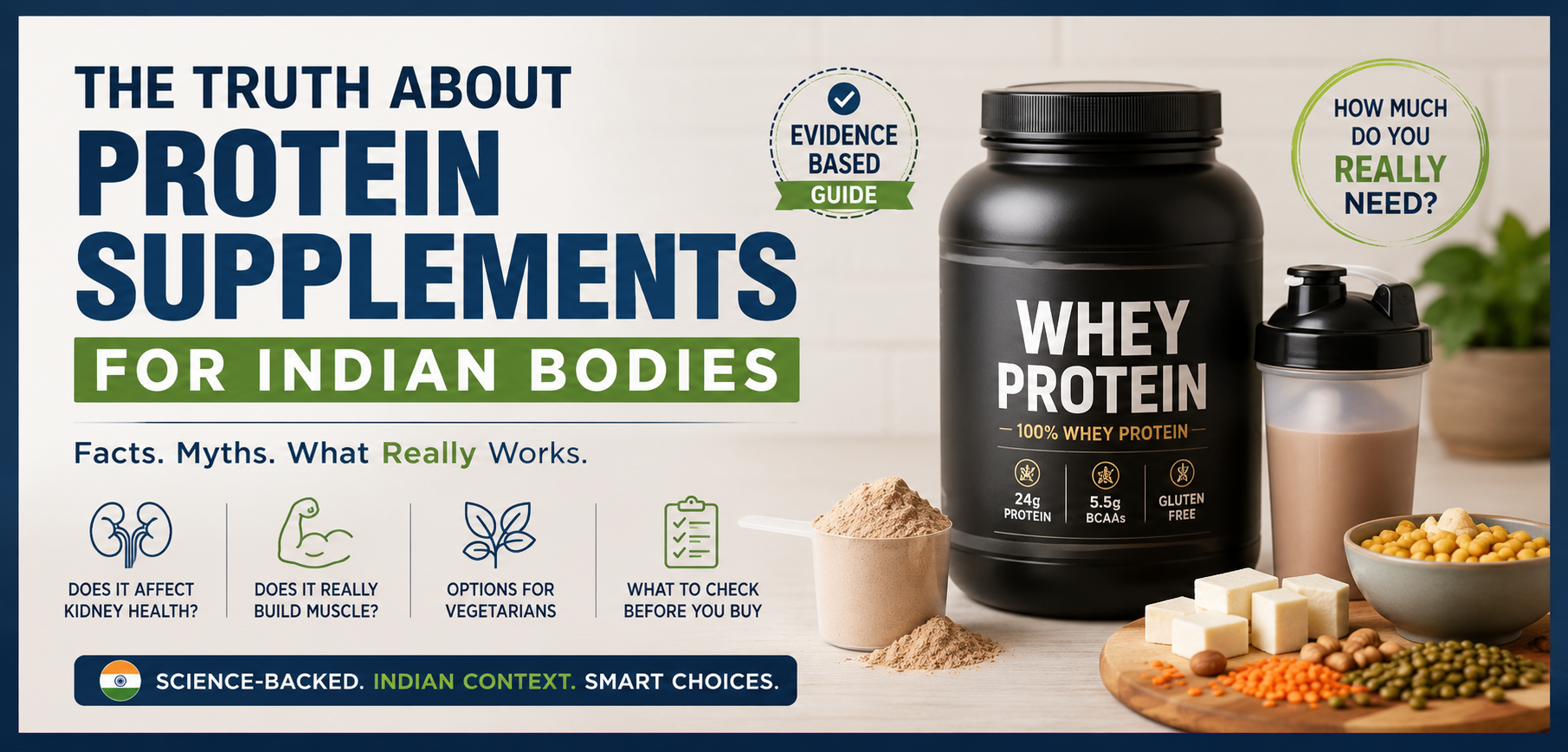
The Truth About Protein Supplements for Indian Bodies
Protein supplements have become almost synonymous with gym culture in India. Walk into a fitness centre and you will hear everything from “whey damages the kidneys” to “Indian bodies cannot digest protein properly,” while social media often suggests that a protein shake is essential for anyone who wants to build muscle.
The Short Answer
The reality is much less dramatic.
Protein supplements are neither magic nor inherently dangerous. They are simply a convenient way to increase protein intake when food alone does not provide enough. Whether you actually need one depends on your diet, body weight, age, activity level, health status and goals.
For most healthy adults, the important question is not “Is whey good or bad for Indians?” but rather:
How much protein do I actually need, how much am I already getting from food, and is a supplement the safest and most practical way to close the gap?
Do Indian Bodies Need a Different Kind of Protein?
There is no scientific basis for the idea that Indians have a fundamentally different biological response to protein simply because they are Indian.
Human digestion and muscle protein synthesis operate through the same basic physiological mechanisms. What can be different is the typical Indian diet.
Many Indian diets are built around cereals such as rice and wheat, with varying amounts of pulses, dals, dairy, soy, eggs, fish or meat. Depending on the person’s eating pattern, total protein intake may be considerably lower than what is useful for someone who is actively training.
The Indian Council of Medical Research–National Institute of Nutrition (ICMR-NIN) lists a protein RDA of approximately 0.83 g/kg/day for healthy sedentary adults in its 2020 recommendations.
That is a recommendation for basic nutritional adequacy—not necessarily an optimal target for someone performing regular resistance training.
For example, a 70-kg sedentary adult would need roughly:
70 × 0.83 = 58 g protein/day
A person who is regularly lifting weights may reasonably require substantially more.
How Much Protein Do You Need If You Exercise?
There is no single number that applies to everyone.
For a healthy adult doing resistance training, a practical range often used in sports nutrition is approximately 1.2–1.6 g/kg/day, with higher intakes sometimes useful depending on the individual’s training volume, calorie intake, age and body-composition goal.
Research supports the idea that increasing protein intake can enhance gains from resistance training, but the benefit eventually plateaus. A large meta-analysis involving 49 studies and 1,863 participants found that protein supplementation improved muscle strength and fat-free mass during prolonged resistance training, with little additional benefit beyond approximately 1.6 g/kg/day for muscle mass.
Example
For a 70-kg person:
| GoalApproximate daily protein | |
|---|---|
| Basic nutritional adequacy | \~58 g |
| Regular exercise | \~85–110 g |
| Serious resistance training | \~100–112 g+ |
These are practical ranges, not prescriptions. A person’s age, calorie intake, training status, body composition and medical conditions can change the appropriate target.
The Most Important Point: Protein Powder Is Food Convenience, Not Medicine
A whey protein shake does not contain a special form of protein that automatically builds muscle.
Your body breaks dietary proteins into amino acids and uses them for many functions, including muscle repair and synthesis.
A protein supplement simply makes it easier to consume a concentrated amount of protein.
Think of it this way:
Chicken → protein
Dal → protein
Milk/curd → protein
Eggs → protein
Soy → protein
Paneer → protein
Whey protein → protein
The nutritional profile, digestibility and amino-acid composition differ, but the fundamental purpose is the same.
When Does a Protein Supplement Actually Make Sense?
A supplement can be useful when your normal diet consistently falls short.
For example, imagine someone needs approximately 100 g of protein per day but typically gets:
- Breakfast: 15 g
- Lunch: 20 g
- Snack: 5 g
- Dinner: 25 g
That is only 65 g.
Adding a shake containing approximately 20–25 g of protein could close much of the gap without requiring a dramatic change to every meal.
This is particularly convenient for people who:
- have busy work schedules
- struggle to eat enough protein through normal meals
- follow vegetarian diets
- have a low appetite
- are travelling
- train regularly
- need a convenient post-workout or between-meal option
The supplement is solving a logistical problem, not providing a magical muscle-building effect.
Whey Protein: Is It Safe?
For healthy adults, whey protein is generally considered a safe and effective source of high-quality protein when consumed appropriately.
Whey is a milk-derived protein and contains all essential amino acids. It is also relatively rich in leucine, an amino acid involved in stimulating muscle protein synthesis.
Clinical evidence supports the usefulness of protein supplementation alongside resistance training for increasing lean mass and strength.
But “safe for most healthy adults” does not mean “safe for absolutely everyone.”
People with kidney disease, significant liver disease, certain metabolic disorders, milk-protein allergy or other medical conditions should discuss protein intake with their doctor or registered dietitian rather than independently adopting a high-protein diet.
Kidney Safety Matters
Does Whey Protein Damage the Kidneys?
This is one of the most common concerns in India.
The answer requires an important distinction.
Healthy kidneys are not the same as diseased kidneys.
A high-protein diet can increase certain markers of kidney workload, but this should not automatically be interpreted as kidney damage.
Available evidence does not establish that appropriately consumed higher protein intake causes kidney disease in healthy adults. However, people who already have chronic kidney disease or impaired renal function may need individualized protein management.
A recent systematic review of dietary protein and health outcomes noted that evidence regarding protein intake and kidney-disease risk in healthy adults remains limited, while established kidney disease is a different clinical situation requiring appropriate management.
Therefore:
Healthy adult + appropriate protein intake ≠ automatically kidney damage.
Known kidney disease + high-protein supplementation without medical guidance = poor practice.
If you have a kidney condition, don’t use a gym trainer or supplement salesperson as your medical advisor.
“Indian Kidneys Are More Sensitive” — Is That True?
There is no established medical rule stating that Indian kidneys cannot safely process whey protein because of ethnicity.
What matters far more is:
- existing kidney function
- hydration
- total protein intake
- medications
- underlying medical conditions
- overall diet
- age
- body composition
A person’s nationality is not a useful clinical test for deciding whether protein powder is appropriate.
What About Vegetarian Indians?
This is where the discussion becomes more interesting.
Vegetarian diets can absolutely provide enough protein.
However, some plant proteins have lower digestibility or less favourable essential-amino-acid profiles than high-quality animal or dairy proteins. This does not mean vegetarian diets are inadequate. It means that vegetarians may need to pay more attention to protein quantity, variety and overall diet composition.
Useful Indian vegetarian protein sources include:
- Dal
- Rajma
- Chana
- Soybeans
- Tofu
- Soy chunks
- Milk
- Curd
- Paneer
- Greek yogurt
- Peanuts
- Nuts and seeds
- Whey protein
Combining different plant foods across the day can help improve the overall amino-acid profile of the diet.
ICMR-NIN’s protein guidance has historically recognized the importance of dietary combinations for protein quality, particularly in vegetarian diets.
Whey Concentrate vs Whey Isolate
Not all whey products are identical.
Whey concentrate
Whey concentrate generally contains a substantial amount of protein but also retains more lactose, carbohydrates and fat than highly purified whey products.
It is often less expensive.
For many people, it is perfectly adequate.
Whey isolate
Whey isolate undergoes additional processing to increase the protein concentration and reduce much of the lactose and other components.
It can be useful for people who:
- have difficulty tolerating lactose
- prefer a higher protein percentage
- want fewer carbohydrates or fats from the powder
But isolate is not automatically more effective at building muscle simply because it is more expensive.
If a person tolerates concentrate comfortably, paying substantially more for isolate may provide little practical advantage.
What If Milk Gives You Gas or Bloating?
This is relatively common and does not necessarily mean you cannot consume protein powder.
Possible explanations include:
- lactose intolerance
- consuming too much at once
- sweeteners or sugar alcohols
- other ingredients in the product
- drinking the shake very quickly
- simply having a large volume of liquid
A person who experiences digestive symptoms with whey concentrate may tolerate whey isolate better because it contains considerably less lactose.
Alternatively, a plant-based protein such as soy or a blended plant protein may be considered.
However, persistent digestive symptoms should not simply be blamed on protein powder. Recurrent abdominal pain, diarrhoea, blood in stool, unexplained weight loss or persistent gastrointestinal symptoms deserve medical evaluation.
Does Protein Powder Make You Bulky?
No.
Protein powder does not automatically make someone muscular or bulky.
Muscle growth requires an appropriate combination of:
Resistance training + adequate protein + sufficient energy + recovery + time
If someone consumes excessive calories while taking protein powder, they can gain body fat.
If they consume an appropriate calorie intake and train effectively, adequate protein can support muscle growth.
The powder itself does not determine whether someone becomes lean, muscular or overweight.
Can You Build Muscle Without Protein Powder?
Absolutely.
In fact, you can build an excellent diet without using protein supplements at all.
For example, a person could construct a high-protein Indian diet around:
Breakfast: Eggs + milk/curd + whole grains
Lunch: Dal + rice/roti + vegetables + curd
Snack: Roasted chana / soy / yogurt
Dinner: Paneer/tofu/eggs/fish/chicken + vegetables + roti/rice
Depending on portions, this can provide substantial protein.
The problem is that many people underestimate how much protein they actually consume.
That is why calculating your approximate daily intake for a few days can be much more useful than immediately buying a supplement.
Is One Scoop of Whey Enough?
That depends on what your diet is already providing.
A typical serving may provide approximately 20–30 g of protein, depending on the product.
If you need 100 g/day and are already getting 85 g from food, one serving may be enough.
If you are getting only 45 g, one shake may still leave you well short.
The correct approach is:
Determine requirement → estimate dietary intake → identify the gap → supplement only the gap.
Not:
Buy protein → drink two or three scoops → hope it works.
Do You Need Protein Immediately After the Gym?
The famous “30-minute anabolic window” is often exaggerated.
Protein around exercise can be useful, but the overall protein intake across the day is more important than obsessing over a tiny post-workout window.
Research examining protein timing and type suggests that protein consumed around exercise can support gains in muscle mass and strength, but the broader dietary pattern remains important.
If you train at 6 PM and eat a proper protein-rich dinner at 7–8 PM, you do not need to panic because you didn’t drink a shake five minutes after your final set.
How Much Protein Should You Have in One Meal?
Rather than consuming almost all your protein in one enormous shake, it is generally sensible to distribute protein across meals.
For someone targeting approximately 100 g/day, a practical structure could look like:
- Breakfast: 20–25 g
- Lunch: 25–30 g
- Snack/post-workout: 20–25 g
- Dinner: 25–30 g
This is only an example—not a universal prescription.
The bigger objective is to consistently reach an appropriate daily intake while maintaining a balanced diet.
What About Protein Supplements for Weight Loss?
Protein can be useful during fat loss because adequate protein helps preserve lean mass while someone is in a calorie deficit.
It can also improve satiety for some people.
But a protein shake is not a fat-burning product.
If a shake adds significant calories to an already adequate diet, it can actually make weight loss harder.
For weight management, the question should be:
Does this protein supplement help me meet my protein target without unnecessarily increasing my total calorie intake?
If yes, it can be useful.
If you’re already eating enough protein, adding another 300–400 calories from shakes may accomplish very little.
Buying Protein Safely
What Should You Look for When Buying Protein in India?
This is arguably more important than deciding between whey and plant protein.
1. Check the actual protein quantity
Don’t judge a product by the size of the container or marketing claims.
Look at:
Protein per serving
and
Serving size
For example, “25 g protein” sounds impressive until you discover that the serving size is 50 g.
2. Read the ingredient list
A simpler product is generally easier to evaluate.
Look for unnecessary proprietary blends or an enormous list of ingredients that you do not understand.
3. Check the manufacturer
Buy from a reputable manufacturer and an authorized seller.
Avoid suspiciously cheap products from unknown online sellers.
4. Check the FSSAI information
Food supplements sold in India are regulated under India’s food-safety framework. FSSAI specifically regulates health supplements, nutraceuticals and foods for special dietary uses, including products intended for sportspersons.
5. Look at the batch and expiry information
Do not ignore:
- batch number
- manufacturing details
- expiry date
- manufacturer information
- licensing information
- packaging integrity
6. Be suspicious of miracle claims
A protein powder should not be marketed as a treatment for diabetes, kidney disease, obesity or other medical conditions without appropriate regulatory authorization.
FSSAI regulations restrict disease-treatment and disease-prevention claims for these products unless specifically permitted.
What About “Mass Gainers”?
Mass gainers are often protein powders combined with substantial amounts of carbohydrates and calories.
They can be useful for someone who genuinely struggles to consume enough calories.
But many people buying them do not actually need them.
If your goal is to gain muscle while controlling body fat, you may be better served by:
adequate protein + normal meals + a controlled calorie surplus
rather than automatically drinking a very high-calorie mass gainer.
What About “Protein Bars” and Ready-to-Drink Shakes?
The word protein on the front of a package does not automatically make a product healthy.
Check:
- protein per serving
- total calories
- added sugar
- saturated fat
- fibre
- sodium
- ingredient list
A protein bar containing 10 g protein and 300 calories is very different from a 25 g protein product containing 150 calories.
The nutrition label matters more than the marketing photograph.
Are Indian Protein Supplements Reliable?
The Indian supplement market has improved considerably, but consumers still need to be careful.
FSSAI has specifically highlighted concerns around sports nutrition products, including authenticity, traceability, labelling and the possibility of products being adulterated or containing prohibited substances.
This is particularly important for competitive athletes.
If you compete under anti-doping regulations, supplement contamination can become a serious issue. FSSAI’s rules for foods for sportspersons address prohibited substances under the World Anti-Doping Agency framework.
Therefore, buying from an authorized source and choosing products with credible quality-control/testing information is important.
Common Protein Myths — Quickly Explained
Myth 1: “Protein powder is steroids.”
False.
Whey protein is a dietary protein. Anabolic steroids are pharmacological agents with completely different mechanisms and risks.
Myth 2: “Indian bodies cannot handle whey.”
False.
There is no biological rule that Indian people cannot digest or use whey protein.
Individual tolerance is what matters.
Myth 3: “Whey always damages the kidneys.”
False.
Healthy people and people with kidney disease are not the same clinical population. Existing kidney disease requires individualized medical advice.
Myth 4: “You must drink protein within 30 minutes of exercising.”
Overstated.
Total daily protein intake and overall nutrition are more important than obsessing over a narrow anabolic window.
Myth 5: “More protein means more muscle.”
Not indefinitely.
Protein supports muscle growth, but the benefit plateaus. Research suggests that beyond approximately 1.6 g/kg/day, additional protein provides little further benefit for muscle mass in many resistance-trained adults.
Myth 6: “Vegetarians cannot build muscle.”
False.
Vegetarians can build substantial muscle with adequate total protein, appropriate food choices, resistance training and sufficient energy.
Myth 7: “Expensive protein is automatically better.”
False.
Price does not determine protein quality.
Look at the nutrition facts, ingredient list, manufacturing standards, testing and whether the product fits your dietary needs.
Who Should Be More Careful With Protein Supplements?
Speak with a doctor or qualified dietitian before substantially increasing protein intake if you have:
- chronic kidney disease
- significant liver disease
- a history of kidney stones or other renal problems
- metabolic disorders
- a diagnosed gastrointestinal disorder affecting nutrition
- milk-protein allergy
- pregnancy or breastfeeding considerations
- a medical condition requiring a specialized diet
- medications that affect kidney or metabolic function
Children and adolescents should not independently start bodybuilding-oriented protein supplementation simply because they go to the gym.
FSSAI’s rules for certain foods for sportspersons include specific restrictions and medical-advice requirements for vulnerable groups.
A Better Way to Think About Protein
Instead of asking:
“Should I take whey?”
Ask five questions:
1. What is my protein requirement?
Calculate a reasonable target based on body weight, activity and goal.
2. How much protein am I already eating?
Track your normal meals for several days.
3. Am I consistently falling short?
If not, you may not need supplementation.
4. Can food solve the problem?
If eggs, dairy, soy, dal, legumes, fish, chicken or other foods can comfortably provide the required protein, a supplement is optional.
5. Would a supplement make my diet easier?
If yes, a protein powder can be a useful convenience.
The Key Takeaway
The Bottom Line for Indians
Protein supplements are not inherently dangerous, and they are not essential for everyone.
For a healthy Indian adult, the fundamentals are exactly the same as anywhere else:
Eat an adequate amount of protein. Choose nutritious foods. Train appropriately. Recover adequately. Use supplements when they solve a genuine nutritional or practical gap.
ICMR-NIN’s baseline recommendation for healthy sedentary adults is approximately 0.83 g/kg/day, while evidence from resistance-training research suggests that people pursuing muscle gain may benefit from substantially higher total protein intake, with benefits tending to plateau around 1.6 g/kg/day in many healthy adults.
So, if you are an Indian adult who goes to the gym, there is no special rule saying you need to avoid whey.
And there is equally no rule saying you need it.
Protein powder should be treated as what it actually is: a convenient source of protein—not a shortcut, not a steroid, and not a substitute for a balanced diet.
If your diet already supplies enough protein, you may not need a supplement.
If it doesn’t, a reputable protein supplement can be a practical and evidence-supported way to close the gap.
When to Seek Medical Advice
Do not use internet advice to self-manage unexplained symptoms or a diagnosed medical condition.
If you develop persistent swelling, changes in urination, blood in the urine, persistent gastrointestinal symptoms, unexplained weight loss, severe abdominal pain or other concerning symptoms after starting a supplement, stop treating it as a simple “gym problem” and speak with a healthcare professional.
A doctor can determine whether you need testing such as kidney-function assessment or other investigations based on your symptoms and medical history.
Medical Disclaimer
This article is for general educational purposes and does not replace individualized medical advice. Protein requirements vary according to age, body weight, physical activity, health status, dietary pattern and medical conditions. Anyone with kidney disease, liver disease, a metabolic disorder, pregnancy-related nutritional needs or another significant medical condition should obtain individualized advice from a qualified healthcare professional before substantially changing protein intake or beginning supplements.
Sources: ICMR-NIN protein recommendations; Food Safety and Standards Authority of India (FSSAI) regulations and guidance; and peer-reviewed systematic reviews and meta-analyses of protein supplementation and resistance training.